Project Overview
This Blender addon enables the extraction of articulated skeletons from volumetric motion capture data. Developed as part of an Immersive Media Research Experience for Undergraduates (REU) at Georgia State University, the tool is intended for biomedical analysis to identify strenuous movements from recordings of athletes, as well as for use in film and animation contexts.
The project was mentored by Dr. Zing Yu.
Technical Implementation
Volumetric Motion Capture
Traditional motion capture requires the subject to weat a suit with markers distributed across the body to track movement. In contrast, volumetric motion capture uses multiple cameras to capture the full 3D volume of a subject without them having to wear a suit, producing detailed mesh sequences. This project seeks to leverage the less restrictive nature of volumetric capture to extract movement data similar to traditional motion capture.
System Overview
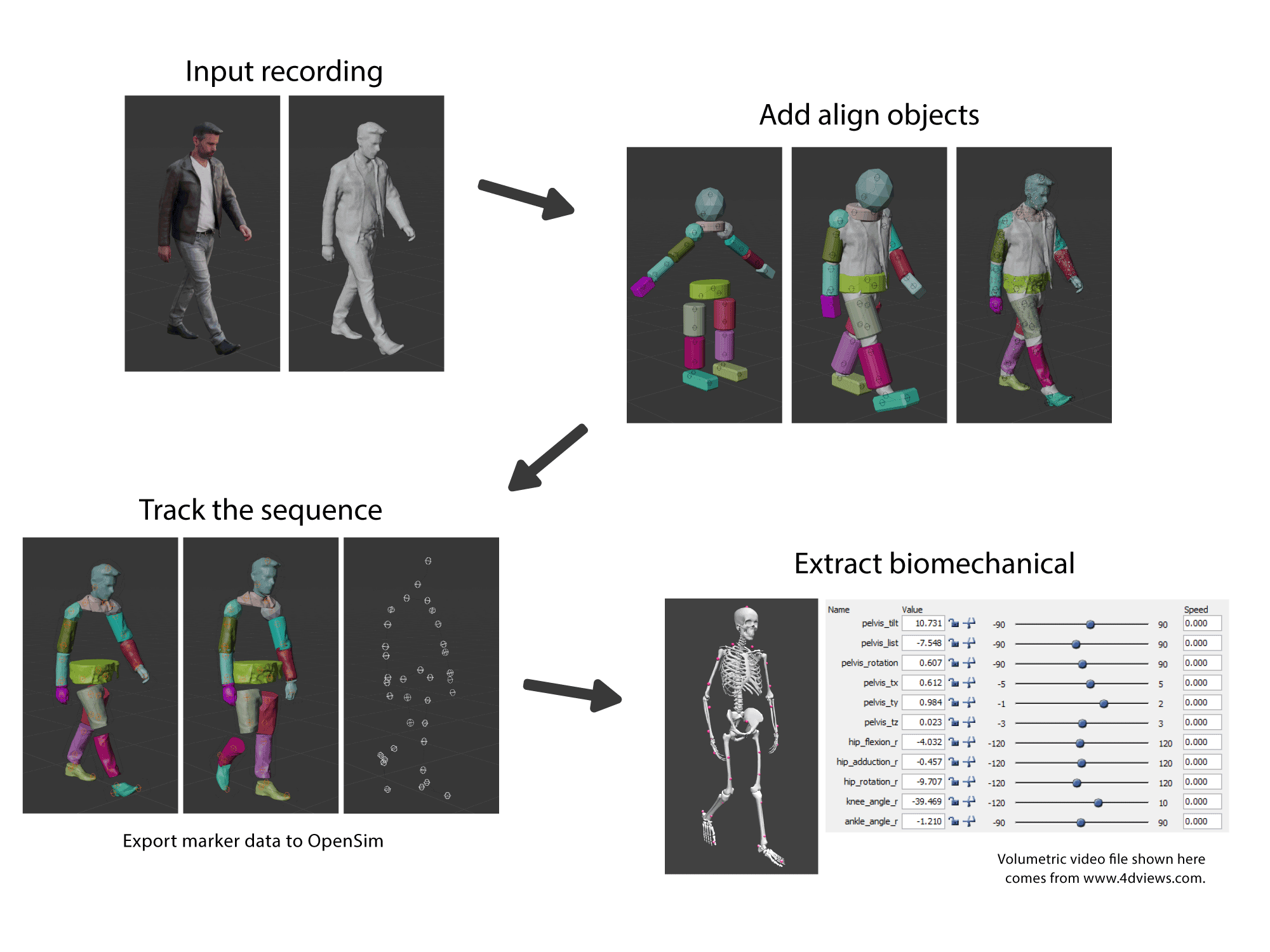
Skeleton Extraction Process
The tool uses the Iterative Closest Point (ICP) algorithm to align joint markers to the volumetric mesh data frame by frame. This allows skeletal motion data to be extracted from markerless capture sessions.
- ICP Algorithm - Utilizes Christopher Gearhart's existing Blender implementation of ICP for precise mesh alignment
- Frame-by-Frame Processing - Processes mesh sequences to track joint positions over time
- Data Exporter - Custom exporter allows for data to be saved in the .trc format required for analysis in OpenSim
Applications
- Biomedical Analysis - Identify strenuous movements and help athletes recover after injury or surgery
- Film & Animation - Extract skeleton data for use in animation pipelines
- Research - Enable biomechanical studies using volumetric capture data